what is a joint account understanding shared finances beyond banking basics
Table of Contents
- Core Definition and Purpose of Joint Accounts: Shared Ownership in Financial Collaboration
- Key Differences Between Joint Accounts and Individual Accounts
- Real-World Applications of Joint Accounts
- Legal Implications: Rights of Survivorship and Jurisdictional Variations
- Joint Accounts vs. Authority Accounts: Understanding Operational Control
- Industries and Professions Where Joint Accounts Are Standard Practice
- Types of Joint Accounts and Their Variations
- Ownership Structures in Joint Accounts
- Joint Tenancy with Rights of Survivorship (JTWROS)
- Tenants in Common (TIC)
- Tenancy by the Entirety (Marital Joint Accounts)
- Hybrid Joint Account Models
- Business Joint Accounts
Financial collaboration does not always require separate ledgers or isolated funds. A joint account represents a powerful tool where two or more individuals merge their financial interests, blending trust with transactional efficiency. From married couples pooling resources to business partners splitting operational costs, these accounts redefine how money moves—eliminating the friction of individual ownership while introducing new layers of accountability and legal complexity.
Yet beneath the surface of convenience lies a web of legal structures, tax implications, and cultural nuances that can turn a simple shared bank account into a high-stakes financial instrument. Whether it’s navigating rights of survivorship in estate planning or mitigating risks of fraud in cross-border transactions, understanding joint accounts demands more than a basic grasp of banking. This exploration dissects their evolution, dissects their variations, and exposes the hidden dynamics that shape their use—from the boardrooms of law firms to the family homes of retirees.

Core Definition and Purpose of Joint Accounts: Shared Ownership in Financial Collaboration
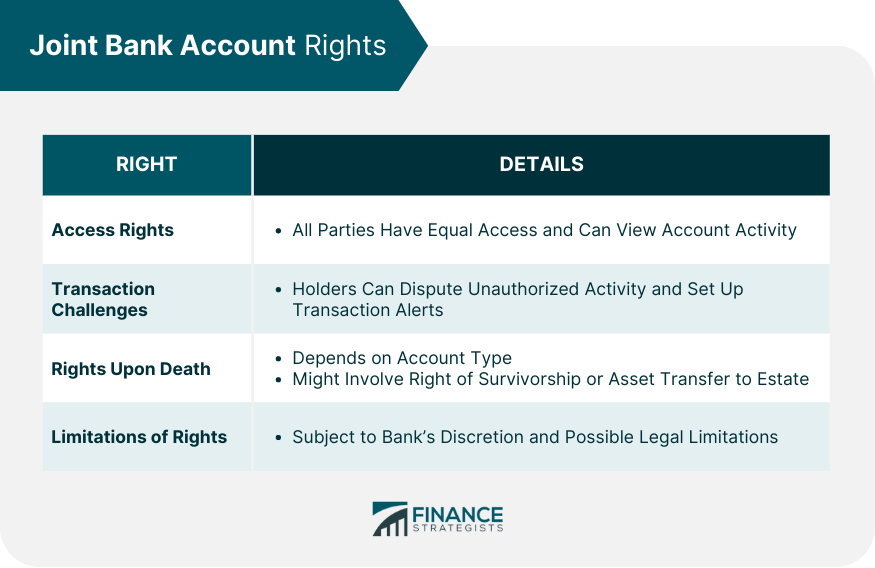
Joint accounts represent a financial arrangement where two or more individuals share equal ownership and operational control over a single banking or financial account. Unlike individual accounts, which vest full authority in a single person, joint accounts distribute rights, responsibilities, and liabilities among co-owners, fostering collaboration in financial management. This structure is particularly valuable in scenarios where shared financial goals—such as estate planning, business ventures, or household expenses—require collective decision-making and resource pooling. Historically, joint accounts emerged alongside the evolution of banking systems in the 19th century, as institutions sought to accommodate family units, partnerships, and communal financial needs. Early implementations were often informal, but regulatory frameworks later standardized their operation, ensuring legal clarity and protection for all parties involved.
The primary purpose of joint accounts extends beyond mere convenience, addressing critical financial and legal needs. For couples, they simplify budgeting and expense sharing, while for business partners, they streamline operational cash flow and joint investments. In estate planning, joint accounts with rights of survivorship ensure seamless asset transfer upon the death of a co-owner, bypassing probate complexities. Meanwhile, family trusts and multi-generational wealth management frequently leverage joint accounts to consolidate assets under unified control. This dual functionality—financial collaboration and legal efficiency—makes joint accounts a cornerstone of modern financial planning.

Key Differences Between Joint Accounts and Individual Accounts
Joint accounts and individual accounts differ fundamentally in ownership structure, liability distribution, and operational flexibility. While individual accounts operate under the sole authority of one account holder, joint accounts distribute control among multiple parties, each with equal or predefined rights. This distinction impacts liability: in joint accounts, all co-owners are typically held equally responsible for account activities, including debts or legal obligations, unless specified otherwise. Conversely, individual accounts isolate financial responsibility to the single account holder, shielding personal assets from co-owner-related liabilities.
Access rights further highlight the divergence. Joint accounts permit any co-owner to initiate transactions—deposits, withdrawals, or transfers—without requiring unanimous consent, unless the account is structured with restrictions (e.g., "joint tenancy with right of survivorship but no right of severance"). Individual accounts, however, restrict actions to the named account holder, offering no shared access. Use cases reflect these differences: joint accounts thrive in collaborative environments, such as married couples managing shared expenses or business partners funding joint ventures, while individual accounts suit solitary financial goals like personal savings or retirement planning.
Below is a comparative table outlining these distinctions:
| Account Type | Ownership | Liability | Access Rights | Use Cases |
|---|---|---|---|---|
| Joint Account | Shared among 2+ individuals; equal or specified ownership percentages. | Collective liability unless otherwise agreed (e.g., one co-owner bears specific debts). | Any co-owner can transact unless restricted (e.g., "anyone can sign" vs. "both must sign"). | Couples, business partners, family trusts, estate planning, shared expenses. |
| Individual Account | Single ownership; no shared control. | Isolated to the account holder; personal assets protected from co-owner liabilities. | Exclusive to the named account holder; no shared access. | Personal savings, retirement accounts, sole proprietorships, individual investments. |
Real-World Applications of Joint Accounts
Joint accounts are ubiquitous in scenarios requiring financial interdependence. Spouses or domestic partners commonly use them to merge incomes, pay shared bills, and build joint savings, fostering transparency in household finances. In business, joint accounts serve as operational hubs for partnerships, allowing seamless fund allocation for payroll, suppliers, or investments. Family trusts employ joint accounts to manage assets across generations, ensuring continuity without probate delays. Even non-profit organizations and community groups leverage joint accounts to pool donations or operational funds, distributing resources collectively.
Beyond traditional banking, joint accounts extend to tangible and digital assets. Co-owned property titles often mirror joint account structures, where all owners share rights and responsibilities. Vehicle ownership follows similar models, with joint titles enabling shared usage and maintenance costs. In the digital realm, cryptocurrency wallets with multi-signature authorization function as joint accounts, requiring approval from designated co-owners for transactions. These applications underscore the versatility of joint accounts in both physical and virtual asset management.
Legal Implications: Rights of Survivorship and Jurisdictional Variations
The legal framework governing joint accounts varies significantly across jurisdictions, with rights of survivorship being the most critical distinction. In accounts with rights of survivorship, upon the death of one co-owner, their share automatically transfers to the remaining co-owners, bypassing probate. This feature is particularly valuable in estate planning, as it avoids delays and legal complexities associated with wills. However, jurisdictions differ in how they classify survivorship rights: some recognize joint tenancy with right of survivorship (JTWROS), while others use tenants by the entirety for married couples or tenants in common, where deceased co-owners' shares pass to heirs rather than surviving co-owners.
Uniform ownership rules further complicate cross-border joint accounts. For instance, the Uniform Probate Code (UPC) in the U.S. standardizes survivorship rights, but individual states may impose additional regulations. In contrast, European Union directives, such as the Second Payment Services Directive (PSD2), mandate transparency in joint account operations but leave survivorship rules to national laws. These variations necessitate careful legal review when opening joint accounts across borders, particularly for expatriates or multinational businesses.
Joint Accounts vs. Authority Accounts: Understanding Operational Control
Joint accounts are often conflated with authority accounts, where one individual holds primary control but grants limited access to others. For example, a parent might open a joint account for a minor child but retain sole signing authority until the child reaches adulthood. This structure differs from traditional joint accounts, where all co-owners typically share equal rights. Tenants in common is another authority-based model, where co-owners hold distinct shares (e.g., 60% and 40%) and can transfer or inherit their portion independently, unlike joint tenancy, which mandates equal shares and survivorship rights.
The decision to choose between joint and authority-based accounts hinges on the purpose: joint accounts prioritize shared ownership and automatic transfer upon death, while authority accounts offer granular control, useful for guardianship or temporary access. Below is a decision-making flowchart to guide account selection:
1. Purpose Identification: - Is the account for collaborative financial goals (e.g., shared expenses, business operations)? - Proceed to Joint Account. - Is the account for controlled access (e.g., parental oversight, temporary delegation)? - Proceed to Authority Account (Tenants in Common or Guardianship Model).
2. Participant Selection: - List all co-owners and their roles (e.g., spouses, business partners, family members). - Assess trust levels and financial compatibility among participants.
3. Bank/Institution Selection: - Research institutions supporting the desired account type (e.g., JTWROS, Tenants in Common). - Verify jurisdictional compliance for survivorship rights and tax implications.
4. Legal Review: - Consult a financial advisor or attorney to draft account agreements specifying rights, liabilities, and dispute resolution. - Confirm inheritance laws align with account structure (e.g., survivorship vs. will-based transfer).
5. Account Setup: - Submit required documentation (IDs, proof of relationship, legal agreements). - Define transaction rules (e.g., single vs. dual signatures, spending limits).
6. Ongoing Management: - Schedule regular reviews to monitor account activity and address conflicts. - Update beneficiary designations as life circumstances change.
Industries and Professions Where Joint Accounts Are Standard Practice
Certain industries and professions rely heavily on joint accounts due to their collaborative nature. Real estate developers and property management firms frequently use joint accounts to pool funds for down payments, renovations, or shared mortgages. Law firms and accounting practices often establish joint client trust accounts to hold funds for multiple cases or clients, ensuring transparency and compliance with fiduciary duties. Family-owned businesses, such as farms or retail stores, leverage joint accounts to manage operational cash flow, payroll, and reinvestments across generations.
In the healthcare sector, joint accounts are used to consolidate reimbursements from multiple insurance providers or to manage shared medical expenses for extended families. Non-profit organizations and charitable trusts also employ joint accounts to pool donations and distribute funds to beneficiaries or projects
Types of Joint Accounts and Their Variations
Joint accounts serve as versatile financial tools, but their structure and application vary significantly depending on ownership needs, legal frameworks, and financial goals. Understanding the distinctions between joint account types—such as Joint Tenancy with Rights of Survivorship (JTWROS), Tenants in Common (TIC), and Tenancy by the Entirety—is critical for individuals, businesses, and families seeking to optimize asset management, inheritance planning, or collaborative financial strategies. Each type carries unique legal implications, tax considerations, and operational flexibility, making it essential to align the account structure with specific objectives, whether for estate planning, business operations, or intergenerational wealth transfer.
Ownership Structures in Joint Accounts
Joint accounts are primarily categorized by their ownership structure, which dictates how assets are shared, inherited, and managed among account holders. These structures are governed by state and federal laws, with variations in how property rights, survivorship, and liability are handled. Below are the three foundational ownership models, each designed to address distinct financial and legal scenarios.
Joint Tenancy with Rights of Survivorship (JTWROS)
Joint Tenancy with Rights of Survivorship (JTWROS) is a common ownership structure where co-owners share equal rights to the asset, and upon the death of one holder, the surviving owner(s) automatically inherit the deceased’s share. This arrangement is frequently used for bank accounts, real estate, and investment portfolios, particularly among spouses, family members, or business partners seeking seamless asset transfer.
Legal Definitions and Ownership Rights: - Equal Ownership: All joint tenants hold an undivided interest in the asset, meaning no single owner can claim a specific portion. - Automatic Inheritance: The surviving joint tenant(s) inherit the deceased’s share outside probate, simplifying estate distribution. - Unified Control: Any joint tenant can manage the asset without requiring consent from others, though transactions may still require signatures from all parties, depending on the institution. - Termination: A joint tenant can sever the arrangement by transferring their interest to a third party, converting the account to Tenants in Common (TIC).
Implications for Inheritance: - Probate Avoidance: JTWROS assets bypass probate, reducing estate administration costs and delays. - Potential Tax Consequences: The IRS may treat the inherited portion as a step-up in cost basis, minimizing capital gains tax for the surviving owner. - Liability Risks: Creditors of one joint tenant may claim the entire asset, as ownership is undivided.
Use Cases: Joint accounts structured as JTWROS are ideal for spouses, domestic partners, or close family members who wish to ensure automatic transfer of assets upon death. They are also popular for real estate co-ownership, where survivors retain full control without probate complications.
Tenants in Common (TIC)
Tenants in Common (TIC) allows co-owners to hold unequal shares of an asset, with each tenant possessing a distinct, transferable interest. Unlike JTWROS, TIC does not include automatic survivorship rights, meaning the deceased’s share passes to heirs via will or intestacy laws, not automatically to the surviving co-owners.
Legal Definitions and Ownership Rights: - Disproportionate Ownership: Owners can hold 1%, 50%, or 99% of the asset, tailored to individual contributions or agreements. - Transferable Interests: A TIC owner can sell, gift, or bequeath their share without requiring other tenants’ consent. - No Automatic Inheritance: The deceased’s share is distributed according to their will or state law, potentially leading to probate proceedings. - Separate Liability: Creditors can only seize a tenant’s specific share, offering limited asset protection compared to JTWROS.
Implications for Inheritance: - Probate Exposure: Assets may undergo probate if the deceased’s will does not explicitly direct the transfer. - Tax Efficiency: Each tenant’s cost basis is tracked individually, which can be advantageous for gift tax planning or charitable contributions. - Flexibility in Succession: TIC is preferable when owners wish to leave their share to non-co-owners (e.g., a parent leaving a property share to a child not involved in the joint ownership).
Use Cases: TIC is favored in real estate investments, business partnerships, or family wealth planning where unequal contributions or future inheritance intentions vary among owners. For example, siblings inheriting a vacation home might use TIC to allow one sibling to sell their share while the others retain theirs.
Tenancy by the Entirety (Marital Joint Accounts)
Tenancy by the Entirety (TBE) is a marriage-specific joint ownership structure available in nine U.S. states (e.g., Florida, New York, Wisconsin) and the District of Columbia. It combines elements of JTWROS and TIC but includes enhanced asset protection for married couples, shielding the property from individual creditors and lawsuits.
Legal Definitions and Ownership Rights: - Automatic Survivorship: Like JTWROS, the surviving spouse inherits the deceased spouse’s share automatically. - Unified Ownership: The asset is held as a single entity, with neither spouse able to sever the tenancy unilaterally. - Creditor Protection: In most TBE states, assets are immune to individual creditors’ claims, though exceptions apply for joint debts or fraud. - Termination: The tenancy ends upon divorce or death, at which point the property converts to the surviving spouse’s sole ownership or is distributed per the will.
Key Differences from JTWROS and TIC:
| Feature | Tenancy by the Entirety (TBE) | Joint Tenancy with Rights of Survivorship (JTWROS) | Tenants in Common (TIC) |
|---|---|---|---|
| Ownership Structure | Married couples only | Any co-owners | Any co-owners |
| Survivorship Rights | Automatic inheritance | Automatic inheritance | No survivorship |
| Creditor Protection | Strong (varies by state) | Limited (varies by state) | Limited (per share) |
| Transferability | Non-transferable during marriage | Transferable (can sever) | Fully transferable |
| Divorce Impact | Terminated | Continues (unless court orders otherwise) | Continues |
| Tax Treatment | Same as JTWROS | Step-up in cost basis for survivors | Individual cost basis |
Use Cases: TBE is primarily used for primary residences, investment properties, or high-value assets by married couples seeking debt protection and simplified inheritance. For example, a couple in Florida might hold their home as TBE to safeguard it from individual lawsuits while ensuring automatic transfer to the surviving spouse.
Hybrid Joint Account Models
In complex financial scenarios, hybrid joint account structures combine elements of JTWROS, TIC, and TBE to address specific needs. These models are particularly common in real estate, estate planning, and business finance, where flexibility and asset protection are paramount.
Real Estate Co-Ownership Hybrids: - JTWROS for Primary Residence: Spouses hold their home as JTWROS for survivorship benefits. - TIC for Investment Properties: Siblings invest in rental properties as TIC, allowing one to sell their share without affecting others. - TBE for Homestead Exemptions: Couples in TBE states use this structure to maximize homestead protections while retaining survivorship rights.
Estate Planning Hybrids: - JTWROS for Liquidity: A parent and child hold a joint brokerage account as JTWROS to ensure quick access to funds post-death. - TIC for Charitable Remainders: An owner holds a property as TIC, leaving one share to a charity while retaining the other for heirs.
Business Joint Accounts: - JTWROS for Operating Capital: Partners in a small business use a joint business account with survivorship rights to avoid disruptions upon a partner’s death. - TIC for Profit Sharing: Investors in a startup hold shares as TIC, allowing unequal exits or transfers without dissolving the partnership.
Business Joint Accounts
Joint accounts for businesses are structured to facilitate operational efficiency, liability management, and tax optimization among partners, shareholders, or affiliated entities. The choice of structure depends on the legal entity type (e.g., LLC, corporation, partnership) and the nature of the business.
Structures for Different Business Entities: - Partnerships: - General Partnerships: Partners may use JTWROS joint accounts for shared expenses, with survivorship rights ensuring continuity. - Limited Partnerships (LP): Joint accounts are often TIC-based, allowing limited partners to transfer their interests without
A joint account is more than a shared bank balance—it is a reflection of trust, a strategy for asset protection, and sometimes an unintended liability. Whether used to simplify inheritance, fuel a business venture, or manage household expenses, its structure demands careful consideration of legal rights, financial compatibility, and relational dynamics. As digital finance reshapes traditional models and global economies redefine shared wealth, the principles governing joint accounts remain timeless: clarity in ownership, transparency in transactions, and foresight in planning. Mastering them means transforming financial collaboration from a convenience into a calculated advantage.
Leave a Comment
Comments are moderated before appearing. The data you submit is processed according to the Privacy Policy of Gestionale.