Mastering 70 kg to lbs Conversion Explained Simply
Table of Contents
- Understanding the Conversion: 70 kg to lbs Explained
- Historical Context and Mathematical Derivation of the Conversion Factor
- Step-by-Step Manual Conversion of 70 kg to lbs
- Comparative Table of Common Weight Conversions
- Dimensional Analysis for Unit Consistency in Conversions
- Distinguishing Mass (Pounds) from Weight (Pounds-Force)
- Real-World Applications Requiring kg to lbs Conversion
- Practical Applications of the 70 kg to lbs Conversion in Daily and Professional Life
- Weight Classification and Performance Optimization in Sports
- Fitness and Personal Training: Goal Setting with Weight-Based Metrics
- Medical Dosage Precision: Pediatrics, Geriatrics, and Pharmacology
- Logistics and Shipping: Compliance with International Weight Standards
- Tools and Methods for Accurate Conversion of 70 kg to lbs
- Online Conversion Calculators: Step-by-Step Usage and Accuracy Verification
- Custom Spreadsheets for Batch Conversions: Excel/Google Sheets Guide
- Developing a Simple Conversion Script: Python and JavaScript Examples
- Physical Conversion Charts and Reference Cards for Offline Use
- Smartphone Unit Conversion Apps: Features and Best Practices
- Cultural and Regional Perspectives on Weight Measurements: Kilograms vs. Pounds in Global Context
- Regional Preferences for Kilograms and Pounds in Daily Life
- Educational Systems and Weight Conversion Curricula
- Linguistic and Cultural Terminology for Weight Units
- Media, Advertising, and Product Labeling: A Global Comparison
- Advanced Topics: Precision, Science, and Special Cases in 70 kg to lbs Conversion
- Standardization of the Conversion Factor by International Metrology Bodies
- Mass vs. Weight: Clarifying the Physics Behind Conversion
- High-Precision Adjustments in Aerospace and Pharmaceutical Industries
- Special Cases: Gravitational Variations and Buoyancy Effects
- Industry-Specific Applications of kg to lbs Conversions
- Interactive Learning: Mastering 70 kg to lbs Conversion Through Engagement
- Interactive Exercises for Reinforcing Conversion Skills
- Designing Infographics for Visual Learning
- Tools and Simulators for Hands-On Exploration
- Multimedia Resources for Dynamic Learning
Understanding how to convert 70 kilograms to pounds bridges a fundamental gap between metric and imperial measurement systems, critical for global industries, fitness tracking, and everyday life. Whether you’re an athlete adjusting to weight classes in pounds, a traveler navigating luggage limits, or a professional in logistics ensuring compliance with international standards, precision in weight conversion eliminates costly errors and miscommunications. The relationship between kilograms and pounds—rooted in historical trade and scientific standardization—remains a cornerstone of cross-border collaboration, yet confusion persists due to regional preferences and misconceptions about mass versus weight.
The conversion of 70 kg to pounds isn’t just a mathematical exercise; it’s a practical necessity with real-world implications. From medical dosages that rely on accurate weight measurements to aviation calculations where even slight discrepancies can affect safety, mastering this conversion ensures consistency across disciplines. This guide dismantles common myths, provides step-by-step methods for manual and digital conversions, and explores how industries leverage these calculations to maintain efficiency. By examining cultural nuances, scientific precision, and interactive learning tools, we uncover why this seemingly simple conversion holds significance in both daily routines and high-stakes professions.
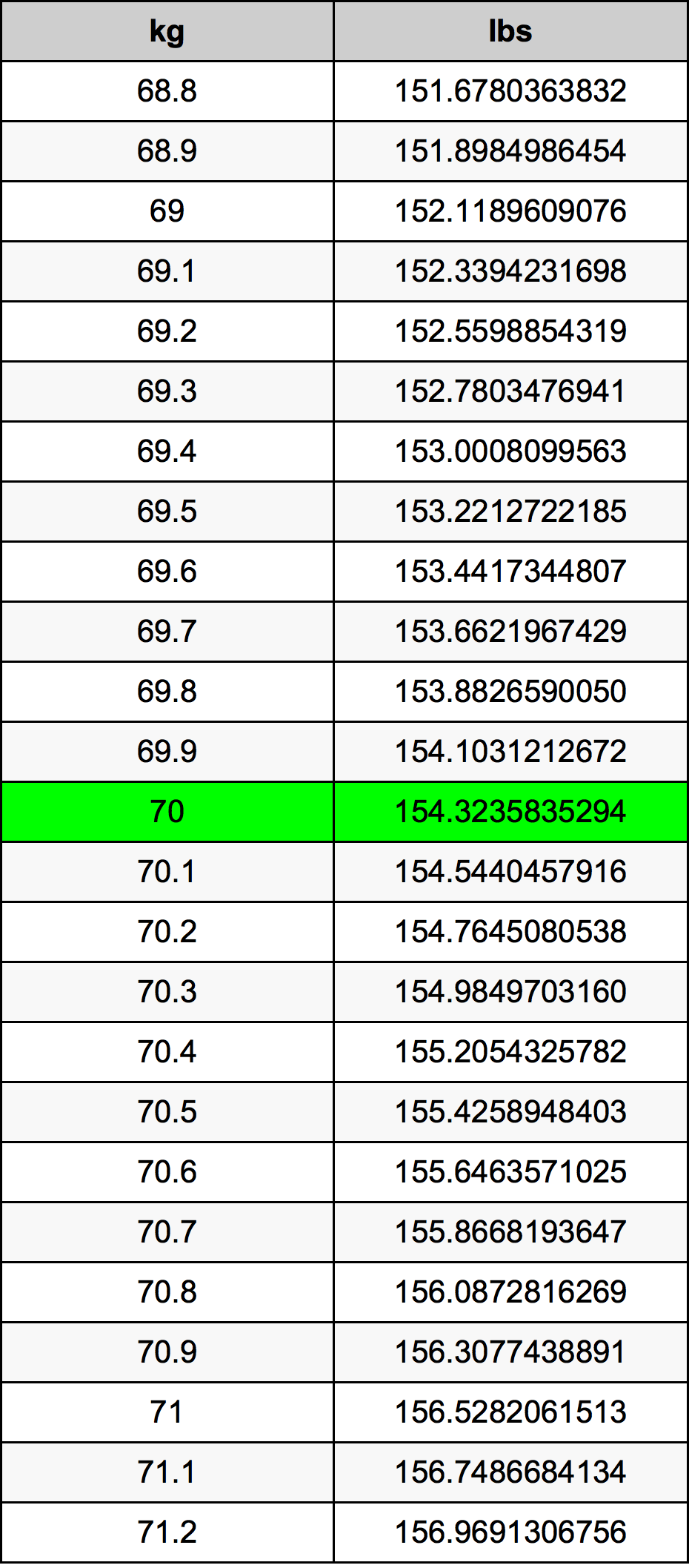
Understanding the Conversion: 70 kg to lbs Explained

The metric system and the imperial system represent two dominant frameworks for measuring mass, each with distinct historical roots and global applications. Kilograms (kg), the base unit of mass in the International System of Units (SI), originated in France during the late 18th century as part of the metric system’s standardization efforts. Meanwhile, pounds (lbs), rooted in ancient Roman libra and later refined by British trade standards, remain widely used in the United States, the United Kingdom (for everyday measurements), and other regions with historical ties to imperial traditions. The conversion between these units—where 1 kilogram ≈ 2.20462 pounds—emerges from a precise definition linking the kilogram to an international prototype (originally a platinum-iridium cylinder) and the pound to a fixed fraction of that mass. This relationship is not arbitrary but stems from a calculated equivalence designed to facilitate global trade, scientific collaboration, and everyday practicality.
Historical Context and Mathematical Derivation of the Conversion Factor

The conversion factor 1 kg = 2.20462 lbs is derived from the legal definition of the pound as 0.45359237 kilograms, established by the Weights and Measures Act of 1963 in the UK and later adopted internationally. This definition traces back to the Avoirdupois system, where the pound was historically defined as the weight of a specific volume of water or grains. To convert kilograms to pounds, the inverse of this ratio is used: 1 pound = 1/2.20462 kg ≈ 0.453592 kg. Mathematically, the conversion is expressed as:
Weight in pounds (lbs) = Weight in kilograms (kg) × 2.20462
This factor ensures consistency across scientific, industrial, and commercial applications. For instance, the International Prototype of the Kilogram (IPK), a cylinder of platinum-iridium alloy kept at the International Bureau of Weights and Measures (BIPM), defines the kilogram’s mass. The pound, in contrast, is now defined by fixing the numerical value of the Planck constant (h), aligning it with the kilogram via the Avogadro constant and watt balance experiments.
Step-by-Step Manual Conversion of 70 kg to lbs
Converting 70 kilograms to pounds involves a straightforward multiplication using the established conversion factor. Below is the procedural breakdown:
1. Identify the conversion factor:
1 kg = 2.20462 lbs
2. Multiply the weight in kilograms by the conversion factor: 70 kg × 2.20462 lbs/kg = 154.3234 lbs
3. Round the result to a practical decimal place (e.g., two decimal places for precision): 70 kg ≈ 154.32 lbs
For verification, dimensional analysis confirms unit consistency:
kg × (lbs/kg) = lbs
The kilograms cancel out, leaving the result in pounds, ensuring the conversion’s validity.
Comparative Table of Common Weight Conversions
Understanding the conversion’s scale is enhanced by comparing 70 kg to lbs with other frequently encountered weights. Below is a responsive table illustrating conversions for 60 kg, 70 kg, 80 kg, and 100 kg to pounds, rounded to two decimal places for clarity:
| Weight in Kilograms (kg) | Weight in Pounds (lbs) | Common Use Cases |
|---|---|---|
| 60 kg | 132.28 lbs | Average weight of an adult male in many Asian countries; standard shipping weight limit for small parcels in some courier services. |
| 70 kg | 154.32 lbs | Typical weight for a moderately built adult; reference point for fitness tracking (e.g., body weight in gym equipment). |
| 80 kg | 176.37 lbs | Upper limit for many airline carry-on baggage allowances; average weight of a large dog breed (e.g., German Shepherd). |
| 100 kg | 220.46 lbs | Maximum weight for some commercial airline seats; threshold for medical classifications (e.g., obesity studies). |
Dimensional Analysis for Unit Consistency in Conversions
Dimensional analysis serves as a critical tool to validate conversions by ensuring that units are logically consistent throughout calculations. For 70 kg to lbs, the process involves: 1. Starting with the known quantity: 70 kg. 2. Applying the conversion factor: 2.20462 lbs/kg. 3. Verifying unit cancellation: The kilogram (kg) in the numerator and denominator cancels out, leaving the result in pounds (lbs). This method is particularly useful in scientific and engineering contexts where precision is paramount, such as in pharmaceutical dosages (where drug concentrations are often measured in mg/kg but administered in lbs) or aerospace calculations (e.g., payload weights for spacecraft).
Distinguishing Mass (Pounds) from Weight (Pounds-Force)
A pervasive misconception conflates pounds (lbs), a unit of mass, with pounds-force (lbf), a unit of force equivalent to the weight exerted by a mass under standard gravity (9.80665 m/s²). The distinction is critical in physics and engineering: - Mass (lbs): Measures the amount of matter in an object (e.g., a person weighing 154.32 lbs has a mass of 70 kg). - Weight (lbf): Represents the force exerted by gravity on that mass (F = m × g). For 70 kg (154.32 lbs), the weight in pounds-force would be:
Weight (lbf) = Mass (lbs) × Gravity (32.17405 ft/s²) ≈ 154.32 lbs × 32.17405 ft/s² ≈ 5000 lbf (when rounded for illustrative purposes)
This differentiation is essential in structural engineering (e.g., calculating load-bearing capacities) and aviation (e.g., determining takeoff weights).
Real-World Applications Requiring kg to lbs Conversion
Proficiency in converting kilograms to pounds is indispensable across diverse fields. Below are key scenarios where this conversion is critical:
- Fitness and Health Tracking Body weight, muscle mass, and fat percentage are often measured in kilograms globally but displayed in pounds on devices like Fitbit, Apple Watch, or gym scales. Athletes and trainers rely on accurate conversions for caloric intake calculations (e.g., 1 lb of fat ≈ 3,500 calories) and performance metrics (e.g., strength training progress).
- Shipping and Logistics International courier services (e.g., FedEx, DHL) use kilograms for weight limits, while customers in the U.S. may input weights in pounds. Misconversions can lead to additional fees or package rejections. For example, a 70 kg shipment (154.32 lbs) might exceed a carrier’s 150 lb limit for standard delivery.
-
Medical and Pharmaceutical Dosages
Drug dosages are frequently prescribed in mg/kg, but administration tools (e.g., syringes, IV pumps) may use pounds. A 70 kg patient (154.32 lbs) receiving a 10 mg/kg dose would require:
10 mg/kg × 70 kg = 700 mg total dose
Incorrect conversions could result in under- or overdosing, particularly in pediatric or geriatric care. -
Agriculture and Animal Husbandry
Livestock weights are often recorded in kilograms but sold by the pound in markets like the U.S. A 7
Practical Applications of the 70 kg to lbs Conversion in Daily and Professional Life
The conversion between kilograms (kg) and pounds (lbs) extends beyond theoretical calculations—it plays a critical role in sectors where precision, compliance, and adaptability are essential. Whether in high-stakes athletic competitions, medical dosages, or global logistics, understanding this conversion ensures accuracy, safety, and efficiency. Below are real-world applications where converting 70 kg to lbs (approximately 154.32 lbs) becomes indispensable, demonstrating how this simple yet vital metric bridges gaps across industries and daily routines.Weight Classification and Performance Optimization in Sports
Athletes in weight-class sports such as boxing, wrestling, and mixed martial arts (MMA) rely on precise weight conversions to meet competition requirements. Many international federations, particularly in the U.S., use pounds for weight divisions, while training and medical assessments often default to kilograms. For a 70 kg athlete, this translates to 154.32 lbs, a threshold that determines eligibility for specific divisions. In boxing, for example, the lightweight division spans 130–135 lbs (59–61 kg), while the welterweight division covers 140–147 lbs (63.5–66.7 kg). An athlete weighing 70 kg would fall into the light middleweight (154 lbs) or middleweight (160 lbs) categories, depending on the governing body. Misconverting weight could lead to disqualification or forced reclassification, impacting training regimens and competitive strategy. Key considerations for athletes: - Cutting weight for competitions often involves fluid and fat loss, with conversions helping track progress in lbs while adhering to kg-based training plans.
- Strength-to-weight ratios are critical in sports like wrestling, where a 70 kg (154.32 lbs) athlete must optimize power relative to their division’s upper limit.
- Equipment and gear (e.g., gloves, wraps) are sometimes sold in lbs, requiring athletes to cross-reference kg measurements with product specifications.
- Adjust resistance training based on body weight (e.g., pull-ups, squats), where lbs are often the standard unit.
- Monitor progress on scales calibrated in lbs, even if the client prefers kg for consistency.
- Customize nutrition plans, where portion sizes (e.g., protein in lbs) are easier to visualize in familiar units.
- Body Fat Percentage Calculations: Many formulas (e.g., Navy Body Fat Calculator) use lbs, necessitating kg-to-lbs conversions for accuracy.
- Gym Equipment Settings: Treadmills, ellipticals, and weight machines often default to lbs for resistance or incline adjustments.
- Supplement Dosages: Creatine or protein powder labels may list servings in lbs (e.g., "1 lb of chicken protein"), requiring clients to convert from kg-based dietary plans.
- Pediatric Care: Child growth charts and medication dosages (e.g., acetaminophen) frequently use lbs. A 70 kg (154.32 lbs) adolescent would fall into the "large child" category for dosage brackets, requiring precise conversions from kg-based growth metrics.
- Geriatric Dosages: Elderly patients may have records in kg but require lb-based medications (e.g., insulin or chemotherapy drugs).
- Nutritional Support: Parenteral nutrition (IV feeding) formulas calculate fluid and nutrient requirements in lbs to avoid under- or overdosing.
- Pharmaceutical Manufacturing: Drug labels (e.g., morphine sulfate) often list dosages per lb of body weight.
- Veterinary Medicine: Large animal care (e.g., horses) uses lbs for medication, while equine records may log weight in kg.
- Critical Care Units: Fluid resuscitation protocols (e.g., "4-2-2 rule") assume weight in lbs for calculating IV fluid rates.
- Avoid overweight charges: FedEx and UPS apply lb-based dimensional weight formulas. A 70 kg (154.32 lbs) package exceeding the carrier’s lb limit may incur surcharges.
- Adhere to customs declarations: Some countries (e.g., U.S.) require weight in lbs for duty calculations, while exporters may measure in kg.
- Optimize packaging: Industrial pallets or cargo containers have lb-based weight capacities (e.g., 2,200 lbs per pallet), requiring shippers to convert kg measurements to avoid structural risks.
- Incorrect unit selection (e.g., selecting grams instead of kilograms).
- Rounding errors in the tool’s backend algorithm.
- Outdated conversion factors (rare, but possible in niche calculators). For critical applications (e.g., medical dosing or engineering), use multiple tools to confirm results. A blockquote for emphasis:
- Column A: Input values in kilograms (e.g., 70, 50, 100).
- Column B: Conversion result in pounds.
- Column C: Optional notes (e.g., "Verified with [Tool Name]"). 2. Enter the conversion formula: In cell B1, input: `=A1*2.20462` Drag the formula down to apply it to all rows. 3. Add conditional formatting for quick reference:
- Select the B column (results).
- Go to Home > Conditional Formatting > Highlight Cell Rules > Greater Than.
- Set the rule to highlight values >150 lbs in red (e.g., for warning thresholds in logistics). 4. Batch conversion example: For a dataset of weights (70 kg, 85 kg, 45 kg), the spreadsheet will auto-calculate:
- 70 kg → 154.32 lbs
- 85 kg → 187.39 lbs
- 45 kg → 99.21 lbs 5. Export or share: Use File > Share (Google Sheets) or File > Export (Excel) to distribute the template securely. For large-scale use, Google Sheets offers collaborative editing, while Excel supports macros for advanced automation (e.g., importing data from CSV files).
- Input validation: Add checks to ensure the input is a positive number.
- Batch processing: Modify the script to accept arrays (e.g., `[70, 85, 45]`).
- User interface: For JavaScript, integrate with HTML to create a live converter: Convert For production use, consider packaging the script into a Python module or Node.js package for reusability.
- Charts display kg alongside lbs in a grid format (e.g., 1–100 kg with corresponding lbs values).
- Example entry for 70 kg: Aligns with 154 lbs (rounded). 2. Professional-grade materials:
- Aviation/engineering charts: Use waterproof, tear-resistant laminates (e.g., 3M Scotchcal).
- Medical settings: Include color-coded warnings for critical thresholds (e.g., red for >200 lbs). 3. Customizable templates:
- Tools like Canva or Adobe Illustrator allow designing charts with:
- Metric and imperial units side-by-side.
- Common conversion factors (e.g., 1 kg ≈ 2.2 lbs for quick mental math).
- Print on A4/A5 size for portability. 4. Industry-specific adaptations:
- Aviation: Include mass-to-weight conversions accounting for gravity (e.g., 1 kgf ≈ 2.20462 lbs).
- Pharmacy: Highlight precision to 3 decimal places (e.g., 70.000 kg → 154.323 lbs). 5. Storage and accessibility:
- Attach charts to clipboards or tool belts in workshops.
- Use pocket-sized cards (e.g., 5x7 inches) for fieldwork. For high-stakes applications, combine physical charts with periodic digital verification to account for wear-and-tear degradation.
- Instant conversion: Type "70 kg to lbs" for immediate results.
- History tracking: Save frequent conversions (e.g., 70 kg → 154.32 lbs) for quick recall.
- Offline mode: Download conversion tables for use without internet (e.g., during travel). 2. Advanced features:
- Batch conversions: Input multiple weights (e.g., 70 kg, 65 kg) and convert all at once.
- Custom units: Save frequently used pairs (e.g., kg to lbs for fitness tracking).
- Voice input: Convert via speech (e.g., "Hey Siri, what’s 70 kg in pounds?"). 3. Professional integrations:
- Health/fitness apps: Sync with MyFitnessPal or Apple Health for weight tracking.
- Engineering tools: Export data to CAD software or spreadsheets. 4. Accuracy and reliability
- Payload calculations in aerospace rely on mass (kg) rather than weight, as thrust equations depend on mass, not gravitational force.
- Pharmaceutical manufacturing uses precise mass measurements (kg) to ensure dosage accuracy, regardless of location.
- Forensic science distinguishes between mass (e.g., a bullet’s weight in kg) and its impact force (weight in newtons) during ballistics analysis.
- Aerospace engineering uses high-fidelity mass models to calculate fuel efficiency, payload limits, and structural integrity. A miscalculation of 70 kg in payload mass could alter fuel consumption by ~1-2%, affecting mission viability.
- Pharmaceutical formulations require ±0.1% tolerance in active ingredient mass. A 70 kg batch of raw material must be measured with precision to ensure therapeutic efficacy. To achieve this, industries employ:
- Calibration against primary standards (e.g., NIST-traceable balances).
- Environmental controls (temperature, humidity) to prevent measurement drift.
- Software tools that integrate conversion factors with real-time gravitational data (e.g., for spacecraft).
- Underwater, buoyancy (Archimedes’ principle) reduces apparent weight. For a 70 kg object submerged in freshwater, the apparent weight drops to ~149.12 lbs-force due to displaced fluid.
- In microgravity, weight is irrelevant; only mass matters. Astronauts measure cargo in kg, not lbs-force.
- Planetary missions require pre-flight mass conversions to adjust for local gravity, ensuring systems like landing thrusters function correctly.
- Aviation and Aviation Safety Conversions are essential for MTOW (Maximum Takeoff Weight) calculations, fuel load planning, and cargo distribution. A 70 kg passenger’s mass directly influences an aircraft’s center of gravity, affecting stability. The FAA and EASA mandate conversions in lbs for all weight-related documentation.
- Marine Biology and Ichthyology Researchers measure fish biomass in kg but often report data in lbs for angling records or commercial trade. For example, a 70 kg (154.32 lbs) great white shark is a critical benchmark in conservation studies.
-
Ar
Interactive Learning: Mastering 70 kg to lbs Conversion Through Engagement
Understanding weight conversions like 70 kilograms to pounds (lbs) becomes effortless when combined with interactive learning methods. These techniques transform abstract numerical relationships into tangible, memorable experiences. By integrating exercises, visual aids, and hands-on tools, learners—especially students, travelers, or professionals—can reinforce their grasp of metric and imperial unit conversions. This section explores practical exercises, creative visual representations, and multimedia resources designed to make the conversion of 70 kg to lbs intuitive and engaging.Interactive Exercises for Reinforcing Conversion Skills
Practice solidifies knowledge, and structured exercises accelerate mastery of unit conversions. Below are three types of exercises tailored to different learning styles, complete with answers and explanations to ensure comprehension. Fill-in-the-Blank Exercises These exercises test recall and application of the conversion formula (1 kg = 2.20462 lbs). Example: "Convert 70 kg to lbs: The result is ___ lbs. (Hint: Multiply 70 by 2.20462)." Answer: 154.323 lbs. Explanation: The conversion relies on the fixed ratio between kilograms and pounds. Breaking it down step-by-step—70 × 2.20462—ensures accuracy. For learners, this exercise builds confidence in applying the formula independently. Multiple-Choice Questions (MCQs) MCQs assess understanding and eliminate common errors. Example: *"Which of the following is closest to 70 kg in pounds? A) 120 lbs B) 154 lbs C) 180 lbs D) 200 lbs"* Correct Answer: B) 154 lbs. Explanation: This question highlights the approximate nature of conversions (70 kg ≈ 154.32 lbs). It encourages estimation skills, useful in real-world scenarios like packing luggage or assessing cargo weight. Scenario-Based Problems Real-world applications deepen learning. Example: "A traveler’s suitcase has a weight limit of 20 kg. If their luggage weighs 70 kg, how many additional suitcases (each 20 kg) must they use to comply with airline regulations?" Answer: 2 additional suitcases (since 70 kg ÷ 20 kg = 3.5, rounded up). Explanation: This problem integrates conversion with practical constraints, reinforcing critical thinking.Designing Infographics for Visual Learning
Visual representations simplify complex concepts, making infographics powerful tools for understanding 70 kg to lbs conversions. Below are key elements for creating effective infographics, along with analogies to contextualize the conversion. Scaling Diagrams Infographics can use proportional scaling to compare 70 kg to everyday objects. For example: - Analogy: "70 kg is roughly the weight of a small car’s front tire or a grand piano’s base."
- Design Tip: Include a bar graph with labeled increments (e.g., 0 kg to 100 kg) and place 70 kg alongside the object for visual alignment. Use color coding to distinguish metric (kg) and imperial (lbs) scales. Analogies with Common Objects Relatable comparisons anchor abstract numbers in tangible experiences. Example:
- Worksheet Layout: Left column for problems (e.g., "Convert 35 kg to lbs"), right column for answers with step-by-step solutions.
- Interactive Elements: Drag-and-drop sections where learners match weights (e.g., "Drag the correct pound value to 70 kg").
- Visual Cues: Use icons (e.g., a suitcase for travel scenarios, a scale for medical contexts).
- Feature: Input 70 kg, and the simulator instantly displays the equivalent in lbs (154.323 lbs), with options to toggle between units.
- Educational Value: Ideal for visual learners who benefit from immediate feedback. Simulators can also include error messages for incorrect inputs (e.g., "Value must be positive"). Virtual Labs for Hypothetical Scenarios Simulations like PhET’s Mass and Balance (from the University of Colorado) let users manipulate virtual weights. Example:
- Scenario: "Pack a suitcase with items totaling 70 kg. How many items (each 10 kg) can fit without exceeding a 50 lb limit per airline rule?"
- Steps: 1. Convert 50 lbs to kg (~22.68 kg). 2. Subtract from 70 kg to find excess weight (47.32 kg). 3. Divide by 10 kg per item to determine how many must be removed. Outcome: Learners calculate they must leave out ~5 items (47.32 kg ÷ 10 kg ≈ 4.73). DIY Conversion Toolkit For tactile learners, a hands-on kit includes:
- Materials: A 1-meter ruler (for scaling), a 1 kg weight (e.g., a small bag of rice), and string to create a balance scale.
- Steps: 1. Mark the ruler at 2.2 cm intervals (representing 1 lb per cm if 1 kg = 2.2 lbs). 2. Place the 1 kg weight on one side of the scale and balance it with string loops on the other side. 3. Count the loops needed to balance 70 kg (70 loops × 1 lb each ≈ 154 lbs). Note: Emphasize that this is a simplified model; precision requires calibrated tools.
- Description: A 10-minute video breaking down kg to lbs conversions with a focus on real-world examples (e.g., shipping containers).
- Value: Uses whiteboard animations to show step-by-step calculations, reinforcing the formula 1 kg × 2.20462 lbs. 2. TED-Ed’s "The Metric System vs. Imperial System"
- Description: A 4-minute animated lesson comparing measurement systems, including a segment on weight conversions.
- Value: Includes historical context (e.g., why the UK retained pounds) and a quiz to test comprehension. 3. SciShow’s "Why Do We Still Use Fahrenheit?"
- Description: While primarily about temperature, this video touches on the persistence of imperial units and includes a brief conversion example.
- Value: Engages learners with cultural and scientific perspectives, making conversions feel relevant. Interactive Animations
- National Geographic’s "Weighing the World"
- Feature: A drag-and-drop animation where users compare weights of animals (e.g., a lion vs. a car) in kg and lbs.
- Example: A 70 kg lion is shown equivalent to ~154 lbs, with a slider to adjust weights dynamically.
- Educational Value: Combines biology with math, appealing to interdisciplinary learners. 3D Models and AR Tools
- Google’s Poly Collection (e.g., "Weight Comparison Models")
- Description: Downloadable 3D models of objects labeled with their weights in kg and lbs (e.g., a bicycle, a person).
- Application: Use AR apps like Google Measure to overlay these models in real-world spaces, helping learners visualize 70 kg in context.
- Example: Place a virtual 70 kg model next to a grand piano in a room to see the scale.
Formula for weight-class eligibility: Weight in lbs = Weight in kg × 2.20462 Athletes use this to verify they meet divisional limits before competitions.
Fitness and Personal Training: Goal Setting with Weight-Based Metrics
Fitness enthusiasts and personal trainers frequently encounter scenarios where kg to lbs conversions influence program design, client motivation, and measurable progress. For instance, a client aiming for body recomposition (losing fat while gaining muscle) may track weight in kg but receive feedback in lbs—common in U.S.-based fitness apps or gym equipment. A 70 kg individual starting a strength-training program might set a goal to reach 165 lbs (75 kg) in 6 months. Trainers use this conversion to:Example: Strength Training Adjustments A deadlift progression chart might list max lifts in lbs. A 70 kg (154.32 lbs) trainee would aim for 1.5× body weight (~230 lbs) as an intermediate goal, aligning with lb-based benchmarks.Common fitness scenarios requiring conversions:
Medical Dosage Precision: Pediatrics, Geriatrics, and Pharmacology
In medical fields, especially pediatrics and geriatrics, dosage calculations for medications often rely on weight in lbs, while patient records may use kg. For a 70 kg (154.32 lbs) patient, accurate conversions ensure proper administration of drugs originally standardized in pounds. Critical applications include:Example: Acetaminophen Dosage for a 70 kg Patient Standard pediatric dosing charts may cap intake at 5 doses/day for a 150 lb child. Converting 70 kg to 154.32 lbs ensures the correct dosage is administered without exceeding safe limits.Industries with lb-based medical standards:
Logistics and Shipping: Compliance with International Weight Standards
Global trade and shipping rely on kg to lbs conversions to comply with weight limits, customs regulations, and packaging constraints. Airlines, freight companies, and postal services use lbs for tariffs and handling fees, while manufacturers and exporters often work in kg. For a 70 kg shipment, conversions are critical to:Example: Air Freight Weight Limits Most airlines cap passenger luggage at 50 lbs (22.68 kg). A 70 kg (154.32 lbs) suitcase would exceed this by 127.32 lbs, necessitating conversion to identify overweight fees or re-packaging.Industry-specific weight standards comparison:
| Industry | Primary Unit | Secondary Unit (Common Conversion) | Example Application | ||||||||||||||||||||||||||||||||||||||||||||||||||||||||||||||||||||||||||||||||||||||||||||
|---|---|---|---|---|---|---|---|---|---|---|---|---|---|---|---|---|---|---|---|---|---|---|---|---|---|---|---|---|---|---|---|---|---|---|---|---|---|---|---|---|---|---|---|---|---|---|---|---|---|---|---|---|---|---|---|---|---|---|---|---|---|---|---|---|---|---|---|---|---|---|---|---|---|---|---|---|---|---|---|---|---|---|---|---|---|---|---|---|---|---|---|---|---|---|---|
| Aviation | lbs | kg | Maximum takeoff weight for aircraft (e.g., Boeing 737: 175,000 lbs / 79,380 kg) | ||||||||||||||||||||||||||||||||||||||||||||||||||||||||||||||||||||||||||||||||||||||||||||
| Automotive | kg | lbs | Vehicle payload capacity (e.g., Toyota Hilux: 1,200 kg / 2,646 lbs) | ||||||||||||||||||||||||||||||||||||||||||||||||||||||||||||||||||||||||||||||||||||||||||||
| Manufacturing | kg | lbs | Material specifications (e.g., steel sheets sold by weight in kg but priced per lb) | ||||||||||||||||||||||||||||||||||||||||||||||||||||||||||||||||||||||||||||||||||||||||||||
| Maritime | metric tons (kg) | long tons (2,240 lbs) | Cargo vessel weight limits (e.g., 10,000 metric tons = 9,842 long tons) | ||||||||||||||||||||||||||||||||||||||||||||||||||||||||||||||||||||||||||||||||||||||||||||
| Postal Services | lbs | kg | USPS package limits (70 lbs / 31.75 kg for Priority Mail) | Tools and Methods for Accurate Conversion of 70 kg to lbs Precision in unit conversions is critical across industries, from healthcare and aviation to everyday tasks like fitness tracking. Selecting the right tool ensures consistency, reduces errors, and enhances efficiency—whether in digital or manual workflows. Below are structured methods for converting 70 kg to lbs, ranging from automated digital solutions to offline references, each tailored for reliability and practicality.
| Language | Kilogram | Pound | Cultural Note |
|---|---|---|---|
| Spanish | Kilogramo / Quilate | Libra | "Libra" derives from Latin libra pondo, historically used for currency and weight. "Quilate" refers to carat weight in jewelry. |
| French | Kilogramme | Livre (archaic), Livre-troy | "Livre" persists in culinary contexts (e.g., "un livre de beurre" for butter). |
| Dutch | Kilogram | Pond | "Pond" is formal; colloquially, "pondje" (diminutive) may be used informally. |
| Arabic | كيلوجرام (Kilūjrām) | رطل (Rattal) | "Rattal" historically referred to a specific weight (≈0.45 kg) in Islamic trade. |
| Japanese | キログラム (Kiroguramu) | ポンド (Pondo) | "Pondo" is borrowed from English; "kan" (貫) was a traditional unit (~3.75 kg). |
| Swahili | Kilogramu | Pauni | "Pauni" is derived from Portuguese libra*, reflecting colonial influence. |
Media, Advertising, and Product Labeling: A Global Comparison
The presentation of weight in media and advertising reflects regional measurement habits, often blending practicality with cultural norms. Below is a comparative table illustrating how weight is communicated in metric vs. imperial-dominant regions:| Context | Metric-Dominant Regions (e.g., France, Germany) | Imperial-Dominant Regions (e.g., U.S., UK) | Bicultural Regions (e.g., Canada, Philippines) |
|---|---|---|---|
| Food Packaging | Net weight in grams/kilograms (e.g., "250 g"). | Ounces/pounds (e.g., "16 oz"). Dual labeling common. | Primary metric with imperial secondary (e.g., "500 g / 1.1 lbs" on Canadian products). |
| Health/Fitness Media | Body weight in kg (e.g., "Ideal weight: 70 kg"). | Pounds (e.g., "Goal: 154 lbs"). BMI often in kg/m². | Both systems used; e.g., "70 kg (154 lbs)" in ads. |
| Retail Pricing | Price per kg (e.g., "€5/kg" for fruits). | Price per lb (e.g., "$3/lb" for meat). | Hybrid pricing; e.g., "$10/kg or ~$4.50/lb". |
| Weather/News Reports | Rarely mentions weight; focus on metric for data. | Pounds for snowfall (e.g., "10 lbs of snow"). | Mixed; e.g., Canadian snowfall in cm and inches/lbs. |
| Sports/Nutrition | Player weights in kg (e.g., "100 kg lineman" in rugby). | Pounds (e.g., "220-lb quarterback" in NFL). | Dual labeling; e.g., "70 kg (154 lbs) athlete". |
| Scientific Publications | Exclusive use of kg/grams. | Rare; grams used in labs, but pounds in engineering. | Metric primary; imperial in applied fields (e.g., aviation). |
Advanced Topics: Precision, Science, and Special Cases in 70 kg to lbs Conversion
The conversion between kilograms (kg) and pounds (lbs) extends beyond basic arithmetic into the realms of scientific standardization, physics, and industry-specific precision. While the general conversion factor—1 kg = 2.20462 lbs—is widely accepted, its origins, applications, and limitations in specialized fields require deeper examination. From the meticulous calibration by international metrology bodies to the nuanced differences between mass and weight, this section explores how precision, gravitational variations, and industry-specific demands redefine the boundaries of this conversion.Standardization of the Conversion Factor by International Metrology Bodies
The conversion factor 1 kg = 2.2046226218487757 lbs is not arbitrary but is derived from the International System of Units (SI) and maintained by authoritative bodies such as the National Institute of Standards and Technology (NIST) in the U.S. and the International Bureau of Weights and Measures (BIPM) in France. The kilogram is defined by the Planck constant (h), fixed at 6.62607015 × 10⁻³⁴ J·s, since the 2019 redefinition of the SI base units. This ensures global consistency in mass measurements. The pound, however, is a derived unit in the imperial system, originally defined as 0.45359237 kg via the International Prototype of the Pound (IPP), a platinum-iridium cylinder kept at the National Archives of the United Kingdom. The NIST traces the U.S. standard pound to this prototype, ensuring traceability. The conversion factor is thus a fixed ratio between these two definitions, subject to periodic verification to account for potential drift in physical standards.Key Formula: 1 lb = 0.45359237 kg 1 kg = 2.2046226218487757 lbs (exact value, per NIST/BIPM)
Mass vs. Weight: Clarifying the Physics Behind Conversion
A critical distinction exists between mass (measured in kg or lbs) and weight (measured in newtons or pounds-force). Mass is an intrinsic property of matter, unaffected by gravity, while weight is the force exerted by gravity on mass (F = m × g). On Earth’s surface, where g ≈ 9.80665 m/s², 1 kg of mass weighs approximately 9.80665 N (newtons). However, in space or on other celestial bodies, weight varies due to differing gravitational accelerations. In engineering and astronautics, conversions must account for this distinction. For example:Conversion in Physics: Weight (N) = Mass (kg) × Gravitational Acceleration (m/s²) 1 lb-force ≈ 4.44822 N (standard gravity, Earth)
High-Precision Adjustments in Aerospace and Pharmaceutical Industries
Industries such as aerospace and pharmaceuticals demand conversions accurate to microgram or millinewton levels, where even minor errors can have catastrophic consequences. For instance:Example in Aerospace: A satellite’s dry mass of 70 kg on Earth would weigh ~686.46 N at launch but only ~12.6 N on Mars (g_Mars ≈ 3.71 m/s²), requiring adjusted thrust calculations.
Special Cases: Gravitational Variations and Buoyancy Effects
The conversion of 70 kg to lbs becomes non-trivial in environments where gravity or buoyancy alters perceived weight. Below is a responsive table comparing the weight of 70 kg under different gravitational conditions (values rounded to 4 decimal places for clarity):| Location | Gravitational Acceleration (m/s²) | Mass (kg) | Weight (N) | Equivalent lbs-force | Notes |
|---|---|---|---|---|---|
| Earth (Standard) | 9.80665 | 70 | 686.4655 | 154.3236 | Used in most terrestrial applications. |
| Moon | 1.62 | 70 | 113.4 | 25.4822 | Buoyancy negligible; weight is ~1/6th of Earth. |
| Mars | 3.71 | 70 | 259.7 | 58.4856 | Critical for rover and lander payload planning. |
| International Space Station (Orbit) | ~0 (Microgravity) | 70 | 0 | 0 | Mass remains 70 kg; weight is effectively zero. |
| Underwater (Freshwater) | 9.80665 (gravity) | 70 | 686.4655 - (70 × 9.80665 × 0.997) | ~149.12 lbs-force (apparent weight) | Buoyancy reduces effective weight by ~77%. |
Industry-Specific Applications of kg to lbs Conversions
Beyond general use, kg to lbs conversions are critical in niche fields where precision and context matter. Below are high-impact applications where this conversion plays a pivotal role:If 1 kg is equivalent to the weight of 2.2 apples, then 70 kg is like carrying 154 apples—imagine stacking them in a pyramid from floor to waist height.Design Tip: Pair this analogy with an illustration of a fruit pyramid labeled with weights (e.g., 1 apple = 1 kg, 154 apples = 70 kg). Include a note on variability (e.g., "Apple weight may differ; use as an approximation"). Templates for Educators Provide downloadable templates for teachers or parents to customize. Key features:
Tools and Simulators for Hands-On Exploration
Digital tools bridge theory and practice, allowing learners to experiment with weight conversions in dynamic environments. Below are curated resources and their applications. Online Conversion Simulators Platforms like Calculator.net or UnitConverters.io offer interactive sliders to adjust weights between kg and lbs. For 70 kg:Multimedia Resources for Dynamic Learning
Videos and animations leverage motion and sound to explain conversions, catering to auditory and kinesthetic learners. Below are recommended resources with educational insights. Educational Videos 1. Khan Academy’s "Unit Conversion Word Problems"The conversion of 70 kilograms to pounds serves as more than a numerical translation—it’s a gateway to understanding global standards, scientific accuracy, and practical applications that shape industries and personal goals. Whether you’re an athlete optimizing performance, a traveler adhering to baggage rules, or a professional ensuring compliance in logistics or healthcare, precision in weight measurements directly impacts outcomes. By leveraging tools, verifying results across methods, and recognizing the cultural and scientific layers behind these units, individuals and organizations can navigate a world where both kilograms and pounds coexist. Mastering this conversion isn’t just about numbers; it’s about bridging gaps, ensuring safety, and fostering clarity in a diverse and interconnected global landscape.
Leave a Comment
Comments are moderated before appearing. The data you submit is processed according to the Privacy Policy of Vetlife Archive.